We Live in a Country …: Reflections on a Nation and Inauguration

West Face of US Capitol: Same place, so different

Photo credits:
Top: Daniel Acker, Bloomberg/Getty Images
Bottom: Samuel Corum, Getty Images North America/Getty Images

It’s already been a week!

OR…

It’s only been a week‽

One week ago from the moment this post went live, only watching a clock would have let you know anything was different, and yet everything had changed with President Biden’s inauguration and the semi-peaceful transfer of power.

Through the windows of my Brooklyn living room, I saw blue skies. On my TV, I noticed the same in Washington D.C. Earlier, as I sat to write my morning pages, an unexpected heavy flurry swirled outside; after, when I closed myself in the kids’ bedroom to meditate, the snow had stopped, but outside appeared cold and gloomy, remaining overcast and gray.

Though I did not record changes in weather in order to compare them to the timeline of He-Who-Shall-No-Longer-Be-Named’s departure from the White House for his final flight on Air Force One, it seemed to me that the further he traveled physically from our government’s seat of power, Mother Nature began to relax. By the time he landed in Florida and deplaned, that blue sky had peaked through, and Kamala Harris was minutes from taking the oath that allowed her to drop “-elect” from her new job title. And by the time our Mini-Wannabe-Mussolini and Melania parted ways to go to their separate bedrooms inside Mar-a-Lago, only the winter coats and accessories (most notably some giant mittens!) revealed the season. The temperature in D.C. at noon reached 42 degrees, right around the average high temperature for the date.

As high noon approached, President Uncle Joe took the oath-of-office at 11:47 am, standing on the same platform that just two weeks earlier hundreds of abhorrent, anti-constitutional, anti-patriotic, apparently ProFa (read: Pro Fascist) insurrectionists had defiled just two weeks earlier. Meanwhile, from my personal view in Brooklyn and the televised one from D.C., though clouds remained, the day now appeared bright and sunny, and I appreciated the fortuitous synchronicity of between our leadership and the weather.

I wondered: Going forward, maybe we could just skip “45” in the presidential count. I mean, there actually have only been 44 people to hold the office; Grover Cleveland’s non-consecutive terms make him both 22 and 24. So why not treat Mr. 45 like so many buildings consider their 13th floors: Technically, within the unforgiving universe of numbers, it exists, but too many people feel better not seeing “13” on the elevator display or buttons, we accept its absence and pretend the 14th floor isn’t … well, you know.

Listening to Biden’s speech, as the morning became the afternoon, as I’ve heard so many others express, I suddenly felt a little bit more relaxed. Certainly, I’m conscious that a new president doesn’t automatically fix anything, much less everything, but in this case, at least my daily expectations had flipped upside down: The glass for our country and our world was now 50% full rather than 90+% empty.

I watched the entire ceremony with a sense of cleansing:

  • Thrilled by the musical performances of all three superstars, especially once Lady Gaga was finished, and the immensity of the moment seemed to make her think, “Did I just really do that? Did this happen?” (Though to both Gaga and JLo: You couldn’t wear a mask until you reached the microphone? Like everyone else?).
  • Moved by the very sight of our new, smiling, non-housefly-attracting VP, whose ascension to the second highest office in the land may be the closest to fruition the “American Dream” ideal of the American Dream has ever reached, marking so many notable historical facts: First female VP; first female person-of-color VP; first PresidentVP of Asian descent; only the fourth first-generation American President/Vice President … and I’m sure there are more.
  • Comforted by the new President’s inaugural speech, filled with aspirational hope but also recognition of reality, I also appreciated the mature, communal concept that “We must end this uncivil war,” which stood in such stark contrast to the authoritarian, gaslighting, abusive-father-yelling-at-his-kids declaration of “This American carnage stops right here and stops right now.”
  • Awestruck by the beauty, depth, hope and ambition of Amanda Gorman presenting her poem “The Hill We Climb”; a magnificent piece of writing that stands alongside Emma Lazarus’s “The New Colossus” as a distillation of what our country should strive for. Maybe they should cast Gorman’s poem in bronze, creating a plaque for the Capitol Rotunda, since I can’t imagine a more perfect response to the Confederates who stormed the building on Jan. 6. When she finished, I thought, “Biden just gave the best speech of his life, and thank god he didn’t have to follow her!

But when the ceremony was over, and I began scrolling through various social media—not doomscrolling, but only barely hopescrolling—I quickly remembered that even with all the positive feelings an sights I experienced and also witnessed in others from afar, we live in a country that does not live up to its full name, and arguably, it never has; or if it did, that pinnacle of states fully united has not been reality since May 29, 1790. We consider Sept. 17, 1787 “Constitution Day,” but that date was simply when the delegates to the Constitutional Convention from the 13 original states agreed to and signed the document. Though even that statement requires an asterisk, for no Rhode Island representative signed, and the state did not officially ratify the Constitution until … May 29, 1790.

Continue reading “We Live in a Country …: Reflections on a Nation and Inauguration”
Shirley Jackson’s “The Lottery” and MAGA Mentality

A week ago Sunday, I participated in an online book club. I had never actually engaged with this group before, though they had been around for a decade, and I first “joined” via Meetup.com over seven years ago. Each month, I wanted to read the selection, but I never would, and the monthly meetups involved a trip into Manhattan that repeatedly felt progressively more difficult as the dates approached.

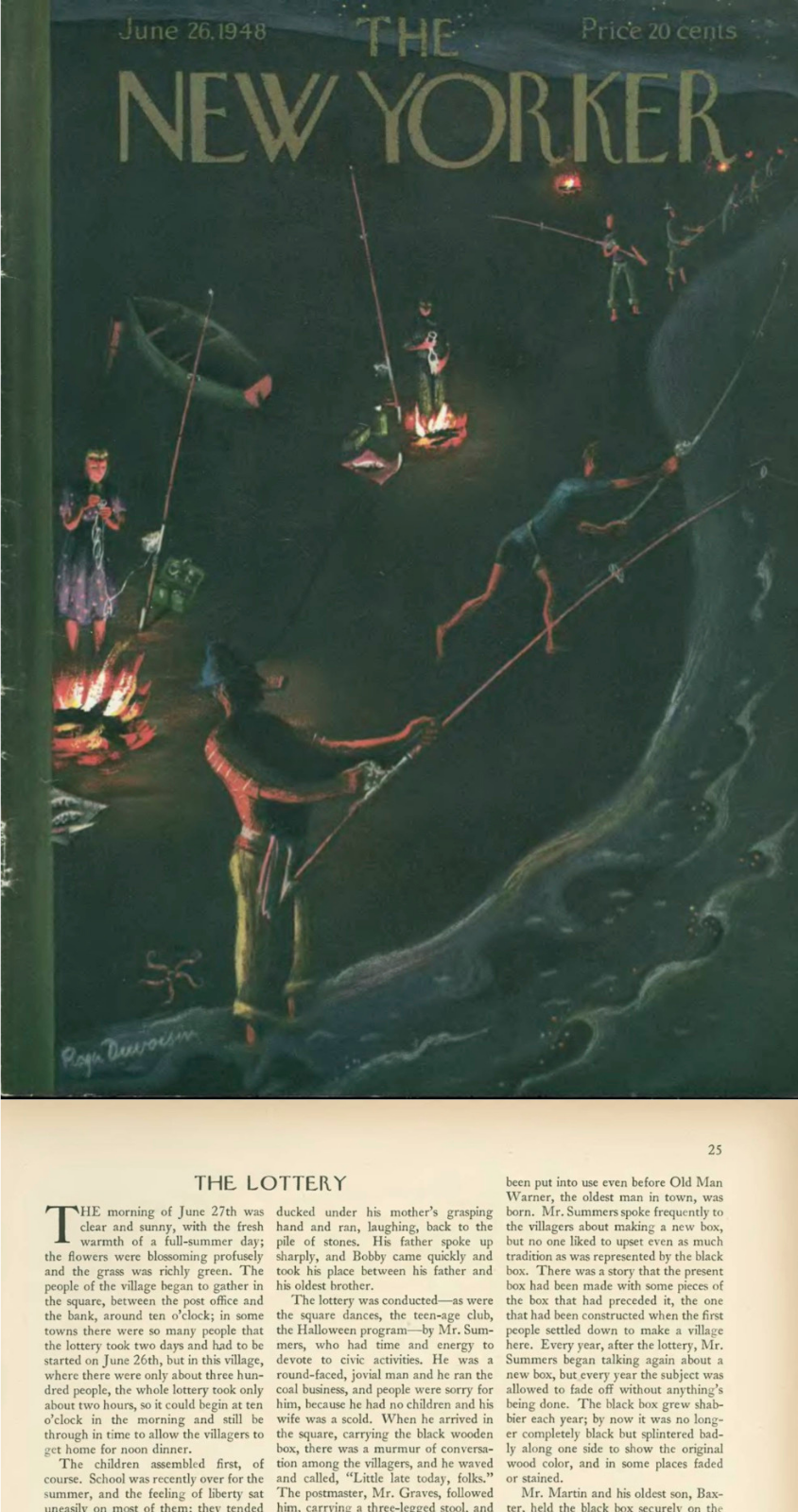
NYer-Lottery-cover-6-24-48The club hadn’t met since March, the pandemic obviously making an in-person meetup impossible. Having not “met” in nine months, and nervous about how well the conversation might flow via Zoom, the organizer decided to run a test using a short story rather than one of literature’s great novels. (When I first joined via Meetup, the group’s name was the Modern Library 100 Book Club.) He selected Shirley Jackson’s iconic and influential short story, “The Lottery.”

A quick read? No travel? Attendance while wearing my elephant slippers and sitting at my desk? The universe had removed all my excuses.

The organizer chose “The Lottery” weeks before a large contingent of insurrectionists who claim to value “law and order” decided that violently attacking the seat of our government provided the best way to “protect” democracy from an election result with which they disagreed. By the time roughly 20 of us gathered on Zoom, the uproar prompted over 70 years ago when Jackson’s 3700-odd words first appeared in the June 26, 1948 issue of The New Yorker seemed especially quaint.

And symbolically prescient.

(That New Yorker link includes the full text of the story as well as audio version by author A.M. Homes. I encourage anyone to go read it, certainly before continuing here.)

Like many (or even most?) people my age, I read “The Lottery” in high school, if not before. I never forgot its ending and always recognized its enormous influence on so many other works of literature, forms of storytelling, and general pop culture. Still, before rereading it on Jan. 9, I knew the story’s climax but recalled little of Jackson’s journey to that denouement

From the start, I was surprised at how completely Jackson foreshadows her twist conclusion. This passage comes from the story’s second paragraph:

Bobby Martin had already stuffed his pockets full of stones, and the other boys soon followed his example, selecting the smoothest and roundest stones; Bobby and Harry Jones and Dickie Delacroix—the villagers pronounced this name “Dellacroy”—eventually made a great pile of stones in one corner of the square and guarded it against the raids of the other boys.

Since the book club discussion, I’ve written literally thousands of words that ventured down multiple tangents about “The Lottery” and its perfect distillation of Trumpists, their ingrained MAGA mentality, and the jaw-dropping, shocking, horrific events at the Capitol on Jan. 6. Upon reflection, I’m surprised that I was shocked by the contemporary resonance of Jackson’s tale, a realization that continued to solidify and grow after our conversation.

Finding my focus proved difficult, though I now realize I was helped somewhat by the historian Heather Cox Richardson whose remarkable daily “Letters from an American” on Jan. 16 focused on the long history of right-wing authoritarianism in America and how easy it has been for some to tap into the collective feelings of resentment and stoke tribal action. Still, even with her much more descriptive and eloquent context in mind, there absolutely must be a glitch in the Matrix when—regardless of metaphor or symbolism—“The Lottery” is a work of fiction, while the Trump presidency is not.

He mesmerized millions of Americans who hoped for his regime to continue, and regardless of what percentage (large or small) were rabid enough to consciously answer his call-to-arms, the images I watched seemed more appropriate for Designated Survivor than CSPAN.

I always found “The First Follower Theory” clever and profound, but Jan. 6 was just the latest example of how terrifying it can also be. “The first follower is what transforms a lone nut into a leader,” Derek Sivers states during his short TED Talk. The first (and second, third, and fourth) followers make the crazy “safe”; they enable others with similar ideas and biases to speak out because they no longer feel alone.

Most movements—good or bad, large or small—work in the same manner as a pyramid scheme, so when the origin—let alone the originator or first leader—becomes lost or forgotten, it is the most ignorant followers who become the most dangerous by being the most complacent. In “The Lottery,” Jackson devotes much description to reinforcing that nobody knows how or why the lottery began; how it has (or hasn’t?) evolved; or even what underlying meanings and symbolism stem from this ritual and the various objects involved.

Jackson makes clear the lottery’s normalization right from the beginning as well, essentially describing it as no different than any other town event. How could it be when Mr. Summers—the man who conducts the lottery—also MCs “the square dances, the teen-age club, the Halloween program.” Mr. Summers is neither a political figure nor a member of law enforcement. He simply “had time and energy to devote to civic activities.”

Why would the townsfolk consider the lottery abnormal? Why would any of them exhibit much curiosity? The crowd expresses a nervous anxiety followed by a cathartic relief before celebrating their safety by killing the sacrifice.

Empathy is non-existent: Not for their neighbors; barely (if at all) for their families. Not once during the story does anyone—including the lottery’s eventual “winner,” Tessie Hutchinson—argue against or question the lottery’s existence. When one person mentions that another town has discussed abandoning the lottery, Old Man Warner—the oldest man in town, i.e., the town elder who has survived 77 lotteries—leads the dismissal and derision of the very possibility of doing so, blaming the crazy youth for whom nothing is ever good enough.

They do it because they’ve always done it.

They do it because they believe this annual sacrifice keeps the crops growing.

They do it because they believe not doing it would court destruction for their way of life.

Until the very end as stones fly towards her, even Tessie’s screams focus on how the selection process was unfair and rigged, not that the entire endeavor is wrong or barbaric. The rest of her family doesn’t even go that far: Her husband simply accepts it while their three younger children celebrate not pulling the black mark themselves. Whether her youngest son Davy understands what’s happening or not bears little relevance on the feeling elicited when reaching, “and someone gave little Davy Hutchinson a few pebbles.”

Meanwhile, Jackson ensures we can’t forget Tessie’s own complicity as she places an enormous hurdle in the way of the reader’s ability to empathize with her too: She’s more concerned about herself than her children. In my reading, it is not a stretch to assume she would toss any of them, onto the pyre to save herself, including little Davy.

Before the family draws their individual lots, but after her husband Bill Hutchinson and Mr. Summers discuss that a married woman selects with her husband’s family, Tessie argues that her daughter Eva and son-in-law Don should have to pick too, which would only lead to lower odds that Tessie would select the black dot. Apparently, if Tessie had to stone Eva, that would be more fair.

There is never a moment when anyone from Mr. Summers on down expresses sorrow nor sympathy to Tessie, either. Not only is the relief among the crowd palpable, they enthusiastically participate in an activity for which even moral relativism offers no real defense. The closest to any expression of distaste Jackson offers arrives with a brief, almost tossed-off comment as Mr. Summers tries to move things along:

“All right, folks,” Mr. Summers said. “Let’s finish quickly.”

How is it possible for a whole town to feel good and have fun committing murder? Belief and confirmation bias are powerful things. A mob mentality not so different from that in the story seemed to occur due to the precise moment in history the story arrived via The New Yorker, one when our current disease of American exceptionalism and entitlement grew exponentially in the wake of World War II.

And that disease is what ultimately led to Trump and what now must be termed “MAGA mentality,” which we should not describe as delusional but rather as an example of inexplicable blind faith. Never-Trumpers have regularly argued, “Country over party,” but that’s the wrong argument. Our political discourse often involves multiple views talking past each other and debating different subjects, and that’s true in this case as well. “RINO” accusations aside, the members of the Cult of Trump believe the only way to save their country is not through Republican or conservative ideology; to them, Republicans may not be as crazy as the “libtards” controlling the Democrats, but they’re just rats in “the swamp” too.

Continue reading “Shirley Jackson’s “The Lottery” and MAGA Mentality”

Thirty-six Days of HoliFilms continued: But Why‽

2020 #36DaysOfHoliFilms logo

As I mentioned at the end of my New Year’s Day post, “I just need to keep showing up.” Though I have long hoped to make my writing my “work”—or a core element of it—at least in the near term, the work I want to write most likely offers little financial reward. Since my wife continues to bring home the bacon for our family, I’m often the one frying it up in a pan. Metaphorically.

Therefore, when I attempt to prioritize my day, especially when much or most of the time revolves around watching the kids or driving them somewhere, as well as all the non-traveling elements involved (i.e., spending an inordinate amount of time searching for parking), the “must” dos and “want to” dos partake in a Battle Royale, usually dominated by whatever tasks gravitate easiest to that horrible word “should.”

When I worry that a task will take more time than I have available, I find it challenging to start a task, especially creative ones, that the time-of-day and other scheduled activities will force me to stop. Instead., too often I put off the the time-consuming task, even if it’s something I enjoy and want to do; or, I keep going and run late for whatever’s next (often picking-up the kids) or allow something else to fall off the to do list.

But if I want to move beyond my current stasis (at worst) or inertia (at best), I must alter this pattern.

As I wrote in yesterday’s #36DaysOfHoliFilms intro, that personal project was part of adjusting my daily priorities. The lack of accountability to an external entity other than myself always creates my largest hurdle. When I participated in the 1999 Boston-NY AIDSRide and the 2009 Westchester Triathlon, I never would have made it to and through the events without their connection to fundraisers. With dozens of supporters donating thousands of dollars in my name, I could never have endured the shame of backing out.

Of course, undertaking both events within that framing was my method of forcing myself not to flake. I hate disappointing other people, but I’m an expert disappointing myself day-to-day. The only way I avoid doing so usually involves some kind of challenging, often time-consuming lifehack. So if there are just too many household or kids-related tasks, or if I feel like I’m not spending enough time seeking new sources of income, the guilt around writing becomes too great. How can I “indulge” myself in that way?

I know balance is possible, and yet I tend to focus on more self-destructive and -defeating thoughts, such as calling a concerted effort toward accomplishing positive goals with long-term benefits akin to an indulgence. Somehow, I am confident that I can achieve such balance if only I can train my brain to find it and—most importantly—stay consistent with my routines. I decided the best way to do that is to, “Pay myself first.”

I don’t remember from whom I first heard that phrase, nor is the idea underneath it new to me. If I resent most of the minutes of my day because of my anger at the limited time I have to focus on achieving my stated goals, performing the tasks I want, and taking noticeable strides forward, then not only do I remain miserable but—as screenwriter, podcaster, and co-creator/executive producer of Showtime’s Billions repeats regularly—I will become “toxic” to myself and everyone around me.

Actually, though I avoid using the word “should” as much as possible, I should have written “I became toxic….”

I provide this preamble as support for the following statement: When “tomorrow” becomes “today,” and another several hundred hopefully interesting and meaningful words appear here, something is going right, even if imperfectly!

I’m not not busy. Managing remote learning for two young children—even once I began regularly dropping them at daily pods—proved exhausting and played a major role in my chronic decision paralysis. Creating extended windows of time and any degree of flow felt unachievable. So throughout 2020, with few (if any) hours during each day solely to myself and no ability to escape to my regular cafes, cowering spaces, and other “work” locales, completing anything beyond the most menial tasks felt undoable, and fomenting the creative energy to write anything—especially while knowing that the chances were better than not that I would get interrupted and derailed—became impossible.

Though the pandemic affected everything, beginning in the Before Times and continuing unchanged through the remainder of 2020. I wanted to accomplish two things:

Continue reading “Thirty-six Days of HoliFilms continued: But Why‽”

Thirty-six Days of HoliFilms (a/k/a #36DaysOfHoliFilms): A Primer

#36DaysOfHoliFilms Title CardsA couple years ago in late November, I decided to start a #MovieDiary with my Instagram feed. My (not original) idea was to capture the first onscreen image as well as the title card, combine them into a single mini-collage, and add a “brief” reaction in the comment.

I didn’t get very far.

This attempt during the Before Times, when visiting a movie theater didn’t carry potentially deadly risk. However, even then, I had realized that parenting little kids (two and four years old at the time) meant fewer visits to the theater and opportunities to binge media at home. So as December rolled around, I attempted to cure my frequent decision paralysis with a mostly pre-scheduled, monthlong festival of holiday movies—a/k/a HoliFilms™️—that I would track with my Instagram #MovieDiary.

The idea was simple: Watch one film related to the end-of-year holidays every day during December. With the exception of two annual mandatory viewings—It’s a Wonderful Life and The Apartment on Christmas and New Year’s Eves, respectively—my selection criteria remained straightforward: Holiday-related or -themed films, either new releases or new to me; or movies that I hadn’t seen in a long time.

In 2018, I made it two weeks before missing a day and adjusting my goal from one movie-per-day to 31 films by the end of the month. Ultimately, I missed that target too, but not as badly as I failed to keep-up with the Instagram posts. I watched 26 films but managed only eight posts. My posting fell behind quickly, and though I continued capturing screenshots in theaters and at home, I never caught-up, eventually choosing instead to move-on.

Determined to do better in 2019, I naturally complicated my criteria. Aside from the two aforementioned constants, I would not include any titles from my 2018 attempt, and if I chose a film not new-to-me, I had to have watched it last over 15 years before.

Why 15? I don’t remember, but an educated (and self-aware) supposition deduces that I wanted to watch Love, Actually in order to see if my late-40s self—older, more-sentimental—would hate it as much as I had upon its 2003 release. (Spoiler: I did.)

By Dec. 6, I had already missed a day, so the plan quickly returned to 31-for-31. And you know what? I came soooooo close, watching 30 holiday-theme films before the ball dropped in Times Square.

But again, though I have a whole collection of screenshots for nearly all 30 of those films, creating the posts—more specifically, writing my thoughts—felt impossible, and not a single film made it to Instagram, Twitter, Facebook, this blog, or anywhere else.

Leading up to the end of November 2020, I had watched fewer films and less television—new or old—than I had in since I was a teenager. As I had never made a conscious choice to reduce my media consumption, rather than offering any form of solace, my FOMO induced anxiety, and really, I have enough of that already.

Though my now four- and six-year-old children consume much of my time and attention—a reality magnified exponentially by the end of March—I can’t legitimately blame them for my lack of video media intake. Rather, the intensity of that previously described decision paralysis grew.

I regularly spent an hour (or more) browsing all my services for something I thought might match my mood and/or attention span. More often than I can count, I would settle on nothing; or I might find myself glued to no-new-news on MSNBC or CNN while doom scrolling Twitter/Facebook/Instagram/etc or imagining that I could achieve Inbox Zero for the day without simply deleting and unsubscribing from everything.

So what better way to solve my indecisiveness than to take the day-to-day choice out of my hands? With Thanksgiving approaching, I thought I’d start early. Why not? If I’ve never completed 31 films, much less one per day for 31 days, why not increase that total to 36, i.e., the number of days from Thanksgiving Thursday through New Year’s Eve? It’s just common (non)sense!

Plus, because I seek perfection in all things including procrastination, and my finally diagnosed ADD and never-confirmed OCD crave form and structure, I also naturally invested several hours creating a personal HoliFilms festival. During that process, I also chose to group films by some identifiable (even if minimal) common element, which in turn would help me determine a schedule to follow.

Then, on Dec. 1, I began this post. I planned to preview this project, thereby allowing me to avoid explaining all these details on Instagram. As I progressed through the month, I could return to this space to expand on any themes and/or discuss individual films.

A funny thing happened on the way to throwing the switch bringing to life these thoughts beyond the synapses in my grey matter; something unlike the dozens of unfinished (and usually abandoned) collections of words composed (especially throughout the 2010s) for this space: After allowing it to accumulate its own thin film of digital dust, I returned to finish it! More importantly, I also already have completed the other elements of this endeavor … well, almost!

Currently (as this post’s publication), 33-of-39 entries live within my Instagram feed. Every movie I watched on and between Thanksgiving and Christmas Days have entries is there. And I will post my comments for the final six films I watched by the end of the week.

Yes, the period between Thanksgiving and New Year’s accounts for just 36 days, not 39; and yes, I named this undertaking “#36DaysOfHoliFilms”; and yes, I failed to make my viewing quota during two previous attempts. Yet, I managed to cap 2020 by landing on the other side of my target: I ultimately watched and included 39 films.

If you’ve made it this far and still wonder, “But why‽” I have a simple, introductory response: “Fair question.”

But that answer must wait—along with more details and entires related to #36DaysOfHoliFilms— for another day.

Maybe even … tomorrow?

Happy New Year: Once Upon a Time … Rebooting a Decade With Year 1

Markus-winkler-EcgyryGygeE-unsplash

I realize saying “good riddance” to 2020 became cliche around midsummer of that turd of year, but right now, as I sit aiming to accomplish my first SMART goal 2021, I can’t help but hope a decade from now I can see last year as the nadir from which my fifth decade will launch with a more positive trajectory.

Sure, all those Best of Te(e)ns conversations ended a year ago, as did the argument: Is 2020 the final year of the previous decade or the first of the next? It’s that damn digit in the tens column creating such confusion and chaos … but I digress.

The majority of 2021 will mark my 50th year of mostly successful breathing, and when next September rolls around, so will the beginning of my aforementioned fifth decade. As I reflect on the past year—and the past seven, 10, 20, 25 years and more—I see so many stories, all of them starring me. And yet, I feel as if I’m watching other people’s lives.

Multiple lives? Multiple lifetimes? I’m not sure if I have landed on the distinction, but certainly, in my 20s, I never considered that any part of my experience no longer felt like mine. Yet, as I feel as if I’m accelerating towards that half-century milestone, I find it increasingly difficult to connect to my lifetimes to date; the ones I’ve lived since my birth.

Suddenly, I have the urge to rewatch Todd Haynes’s I’m Not There, a film I have not seen since its initial release, but one which I believe would resonate with me far more now. I imagine the current lens through which I experience the world would receive Haynes’s multiple actors/characters representing a single figure quite differently than I did over a decade ago.

Last year, I wanted to write more. Every year, I want to write more.

Last year, I intended to prioritize doing so, and yet, my first post in this space—the easiest place for me to write both for myself and the greater Interverse—came four weeks into the year. During the course of the year, I started, stopped, resumed, abandoned, and thought about at least a dozen other posts, but the only other one that made it this space for public consumption only arrived in October. IT might have arrived sooner had the life-as-we-knew-it not become a historical era now known as The Before Times, but then again, it’s not like I suddenly became prolific earlier in the year.

Kelly-sikkema-uUBltZemj1E-unsplash

Photo by: Kelly Sikkema on Unsplash

So this year, in 2021, I’m looking to change the narrative. My narrative. My narratives, I suppose. Maybe I can connect them all. Or maybe I can figure out how to make myself feel connected to all the stories, whether they feel like the progress off and/or overlap with each other … or not.

Once upon a time, I awoke in San Francisco. I remember little, if anything, not implanted via visual or audio artifacts.

Once upon a time, I remember being a not-quite five-year-old who suddenly had two homes rather than one. It wasn’t my fault, of course. My mom explained it to me. My dad explained it to me. I took it well. Boy do I wish I could remember what little me must be covering up.

Once upon a time, I skipped a grade and seven years later felt so young and small during my Freshman year of high school.

Once upon a time, I moved into the dorms at UCLA one week after turning 17 and at least two or three years before I probably was ready to do so.

Once upon a time, 26 years ago today and after a few years of a two-pack-a-day habit in my early 20s, I quit smoking.

Once upon a time, I lived on my own in Los Angeles, working in the film industry, climbing that ladder, but clutching a safety harness that most likely kept getting in my way.

Once upon a time, I accomplished my goal and moved to New York without abandoning my career ambitions or trajectory.

Once upon a time, I made some immature choices, developed my unique form of overly busy and extremely lazy (now well-understood as my too-long undiagnosed ADD), and eventually thought that maybe I had once again determined how to get where I wanted to go.

Once upon a time, 10 years after some fortuitous timing propelled my move to New York, a perfect (metaphorical) storm left me out-of-work, alone and heartbroken due to the unexpected end of my four-year-relationship, and forced to leave not just my rent-stabilized-but-now-unaffordable Upper West Side apartment, but also the entire island of Manhattan; not just moving to Brooklyn, but into a five bedroom share with four other (previously unknown to me) guys in their mid-30s.

Once upon a time, I thought I had hopped back on track, but had I been smarter, I would have known that I had simply hopped onto the wrong train.

Once upon a time, I said “Fuck you 2009!” a year that ended with the (again, metaphorical) punch-in-the-face of a shocking, devastating job loss, followed just a few weeks later by a (literal) punch-in-the-face mugging in a Starbucks!

Once upon a time, at the beginning of 2010, I made one of my best decisions and went on a JDate with my now-wife because my new decade resolution preceded Shonda Rhimes’s best-selling book by nearly six years. Granted, that “yes” occurred around Jan. 7, and the habit didn’t keep.

Once upon a time, after a first long bout of unemployment, I took a job I didn’t really want but absolutely needed to get. It quickly became all-consuming, and I worked harder than I ever had before. But I progressively felt less connected to anything I cared about and enjoyed outside of work. Worse, I was at a loss as to how to get back to myself.

Once upon a time, I had a wonderful wedding, and witnessed the birth of my two amazing children. Suddenly I was a dad; two little kids look at me and see “Daddy.” I remain confused how that works or is even possible.

Once upon a time, months after becoming a dad for the second time, I lost my only dad. Four years later, it continues to feel like yesterday and forever ago simultaneously. More importantly, though, I continue my attempts to understand that reality, my feelings of sadness, guilt, shame, and loss.

Once upon a time, I looked ahead to turning 50, and thought about my two grandmothers, the same age, born just six months apart, both not yet 50 when their grandchild Aaron was born.

Once upon a time, I sat at my computer to write something, unsure what it would be, but hoping the process might help me make sense of these (and other) flashpoints; wishing to reconcile the knowledge that these stories are mine even though I barely recognize the characters, including the protagonist, i.e., me.

2010 started with a happy bang, and as the years progressed, I got lucky in my personal life, creating a new family featuring new milestones every other year. But aside from the three most important people in my world, collectively the last 10 years have been utter shiite, with the past four really stinking-up the joint, and 2020 beating the already decomposing carcass of the previous year’s horse saying, “Hold my beer.”

I’m not a big fan of my 40s, so, rinse and repeat, let’s try again. A new life; the start of another lifetime. Hopefully 10 years from now, I will find this entire ramble quite amusing.

Until then, I just need to keep showing up. Or, actually, start.

Happy New Year.

And, we’re off! 🤞

Four Years Gone: Stephen Mark Dobbs (June 5, 1943-October 25, 2016)

CB6455BD-C97D-4A06-8183-C43D6FAFE589_1_201_aFour years ago today, in the wee hours of the morning, my dad died. Considering how little time I’ve spent in this tiny speck the Interwebs, the fact that I've actually mentioned his passing once is notable. It was nearly 17 months ago, on what would have been his 76th birthday, and before I clicked “Publish” on that post (just a couple entries back), I wrote several thousand other words that ultimately I decided did not fit that moment, for me, on his birthday, at that time. So, I saved them in the digital bowels of my computer.

And now, I’ve done it again: Thousands of more words about him, his life through my eyes, my life in relation to his, and of course, the peaks and valleys of our never-estranged but always complicated relationship.

None of those words exist in this post, but for some reason, this year more than any before—including when he died in 2016—commemorating my dad today, on the anniversary of his death, became imperative. For years now, if I missed a self-imposed deadline to post on this silent website, I would move on. My “Drafts” folder is enormous, and included therein are those thousands of words about Stephen Dobbs.

So on this fourth anniversary of his death, and with the full intent of publishing many (if not all) of those other still-not-ready-for-prime-time thoughts, I decided to memorialize him in the most straightforward way I could while still utilizing my own words.

When my family needed to submit an obituary to the Bay Area publications most central to his life—specifically the San Francisco Chronicle, Marin Independent Journal, and the J Weekly—I volunteered to give it a first pass. After some edits by my stepmother and one of my brothers, the final published version was not so different.

However, what I wrote initially, I wrote for myself and my dad almost more than for anyone else. I wrote it in a manner and containing elements that I believed he would have appreciated; little personal touches that likely possessed more meaning for me than others. My draft needed trimming for length, and therefore, many of those bits of color fell to the cutting room floor.

I’m not sure why I didn’t post my version here in 2016 when I wrote it. In fact, I never considered doing so until this morning when I realized that I would not finish the piece I was writing about him today.

One final note: My dad was a control freak, so of course, he had prepared his own obituary years earlier. It served as useful background for listing the various organizations with which he was involved. He also selected the photo he wanted to use, which offers an unfortunate, but accurate, example of his fashion sense and (I suppose) expresses the reality of his vanity since—as that tie illustrates—this is a photo from the last century. Nevertheless, it fits.

Therefore, with that preamble behind us and several minimal edits since I first wrote it two days after he died, I offer my Final Cut: The (mostly) unabridged version of the obituary of Stephen Mark Dobbs.

Continue reading “Four Years Gone: Stephen Mark Dobbs (June 5, 1943-October 25, 2016)”

New Year, New Decade, New(ish) Focus: Beating Spider-Man to the Reboot Championship

2020_0128-OOFimage-FOCUS_Nina Matthews Photography

courtesy Nina Matthews Photography

I’ve lost count, but math doesn’t lie.

Over the past four weeks, I’ve drafted this post at least a dozen times. It doesn’t feel like four weeks, but I began on New Year’s Day. It doesn’t feel like my fingers have crawled over this keyboard for 20 hours (or more), and I’m scared that it won’t read as if they have either.

Four weeks and more than 20 hours? That seems like a lot, right? I wish I could claim that I was meticulously crafting each sentence, utilizing my thesaurus to choose perfect words—mesmerizing you, kind reader, with my prose.

That would be an inaccurate claim.

These days, I care how people respond to what I write. During my younger years, I spent an inordinate amount of time not caring; just typing, barely editing beyond a spellcheck to get my rant into the world. (Of course, I always cared, but telling myself I didn’t was a wonderful cover for my insecurities.)

Now, I seem to have swung to the opposite pole. When I sit with an idea and find my flow, I try returning to that non-caring place. Whether I accomplish this goal or not—and regardless of where I started—part of my brain inevitably directs my fingers to stray ever so slightly, but enough to explore in detail something that for now should remain a simple signpost along the path to my ultimate destination.

Without fail, that tangent transforms from a single sentence into 10 paragraphs that require literary breadcrumbs to return to my unintentional fork in the road. Besides, this new thread can be its own thing. Meanwhile, if I've lost my own thread, where have I left you?

To those who know me beyond words on a screen, I realize your likely response to the above is, “Duh!” And yet, my difficulty curbing this practice continues to surprise me, which it shouldn't since my wife’s phone still describes me as “Superhero Tangent Man," 10 years after we met. (Avoiding tangents #1: A story related to our first date.)

Continue reading “New Year, New Decade, New(ish) Focus: Beating Spider-Man to the Reboot Championship”

WriMoBloPo 2019 Day 4 Day 1: So Many Drafts, So Few Posts

NaNoWriMo began four days ago.

I am not writing a novel, but last week, I planned to utilize NaNoWriMo as motivation to create my own, let's call it, NoBloWriMo. Or AarBloWriMo? Hmmm … maybe WriMoBloPo? Maybe I need to keep working on this. I digress.

I'm not writing a novel. I'm writing a screenplay. For a film. Or two, because there's also this TV series. Or three? Because one of the scripts–originally a short film–might work better as a play.

Or one. I should stick to one. Because right now, I have none.

Or blog posts. Once easy, they have become impossible, even as every single day, something smacks me in the face, and that voice inside says, "Let's write about this!" They used to be easy, and not because I ever expected to turn them into anything other than random musings. Now, they've become impossible even

I never intended for this space to be an online journal. From that first post more than 15 years ago (Oy!), I simply wanted a place to express the random musings occupying too much space in my over-opinionated, infinitely-interested brain.

Somewhere along the way, as various work and life events (and Twitter; I actually do, in fact, blame those early days of Twitter!) got in the way, translating those thoughts into (coherent?) words on the screen with any regularity became too big of a challenge. Plus, I found a new, more private and introspective outlet.

My blog was not an online journal, and any possible need for it to become one evaporated when (after years of failed attempts) I not only started but also managed to maintain my offline journal. Credit due to Julia Cameron's The Artists Way, for her concept of "Morning Pages" led to my daily journaling practice of the last 10-plus years. The only habit I have sustained with greater perfection is avoiding even a single drag on a cigarette since the day I quit smoking nearly 25 years ago on Jan. 1, 1995.

(Second tangent: SHIT! Anyone out there nearing 50: Is it just me? Or does absolutely everything you encounter or contemplate first and foremost remind you of how old you are? Consider that rhetorical …)

The first rule of "Morning Pages": Don't worry about doing them wrong! As Cameron writes, "There is no wrong way to do Morning Pages–they are not high art. They are not even 'writing.'" Still, I have never eliminated from my consciousness the idea that I must be doing them wrong. From discussions with several others, I'm not alone.

In Cameron's universe, this practice demolishes the barriers otherwise blocking one's creativity; it is the key to helping creative artists recover from what blocks them.

I have dozens of journals, filled with whatever word strings my OCD brain has spit into them. My routine has evolved over the years, and rather than "three pages of longhand, stream of consciousness writing, done first thing in the morning," I tend to use a timer, set to 30 minutes, which usually generates four-plus pages in a standard Moleskine notebook. However, no organization or planning, simply dumping whatever comes out onto the page … well, that's what I do.

I wish "first thing in the morning" was possible. Once upon a time, during that other life of mine B.K. (before kids, natch), it was. Now, there are breakfasts to make, OIT treatments to prepare, kids to dress and take to school/daycare, and of course, none of that considers escaping my own waking-up sleep-haze, or those minimum requirements to start my engine (water, eye drops, coffee, bathroom, etc.).

Rarely does any of it progress smoothly, but I usually still manage to start them before 8 am, which could be "first thing" if a couple little people weren't ensuring that the day starts no later than 6. (Let's not even bring-up how fucked this past Fall-back weekend was!)

I show-up. I write … or scribble … or form stings of letters that reasonably resemble English. And yet, they don't break down my barriers, so … am I doing them wrong?

My intent this NaNoWriMo is mostly just about a different "WriMo": I want to write more and not just say I plan to write more. On one hand, most recently, I've worked on incorporating the lessons of Seth Godin's The Dip, "quitting" the unnecessary things that distract and steal time from my main goals and (therefore) needs. But for some reason, maybe due to its utterly private and risk-lacking nature, I feel some compulsion to not quit this blog but rather to reinvigorate it; or at least, to post to it.

If you found your way here, and to the end of these roughly 900 words signifying … something: Hi. Thanks. Hopefully, at the end of NoBloWriMo ("November Blogging Writing Month") AarBloWriMo (Aaron's Blog Writing Month–problematic acronym!) WriMoBloPo ("Write More Blog Posts"? Not great, but will do for now), I'll realize precisely what I'm want to say here, and maybe more importantly, I'll stop spending time on the seemingly endless drafts I've started, sometimes finished, but never published for the world to see.

Promises, promises.

(Wishing I could wish) Happy birthday Dad: An overdue memorial, first in a series?

2019_06_05_08_05_13_0001Seventy-six years ago today, Stephen Mark Dobbs was born in San Francisco. I write “Stephen Mark Dobbs” because my dad was a fan of using full names. If he mailed something to me, he inevitably addressed the envelope to “Aaron Marc Dobbs.” (Let’s not discuss the weird middle name thing right now, OK?)

My dad turning 76 makes no sense to me. How could it? I still haven’t fully absorbed that …

In under four months, I will be 48.

OR … by the time my dad celebrated his 48th birthday, I was 20 and completing (in a manner of speaking) my third year at UCLA, while he and my stepmother had converted me from an only child into the eldest (by far!) of his four sons.

OR … that my two grandmothers (born just six months apart in 1922) were 49 when I was born.

OR … my grandfather was only 75 in 1994 when he lost his battle with leukemia. How could my dad be older than his father?

OR … that I no longer have a living father.

My dad didn’t make it to 74, much less 76, because on Oct. 25, 2016, he lost his own health battle. His never surpassing nor even reaching my grandfather's age does nothing to lessen this confusion.

I often describe my 1996 move to New York as something that took a long time to happen very quickly, and 20 years later, almost to the day, that also depicted my dad’s decline. Today, over 2 1/2 years later, I still struggle with his death, even more than I did when my youngest brother called to say he had died. The iconic opening of “A Tale of Two Cities” described my 2016 perfectly, with the presidential election only landing at number three on my personal tragedy chart. Just four months before my dad died, my wife’s aunt Evelyn–simply the kindest, most selfless and generous person you could ever meet–had lost her battle with cancer and also passed away.

Fortunately, those two heartbreaking events bookended the arrival of my son Elijah (named for Evelyn).

I miss my dad terribly. Or, I miss having a dad terribly. I still vacillate between the two, wondering if they are one and the same or, in fact, quite different. I suppose both are accurate, but on any given day, one feels stronger than the other.

Watching Elijah transform from newborn to infant to toddler to the crazy, wonderful, curious, hysterical almost-three-year-old (consistently ignoring my pleas to stop jumping on the couch) makes me miss my dad even more. My five-year-old daughter Ruby provides as much wonderment and awe as Elijah, but I did not identify with my dad observing her at 2 1/2 as I do now watching this little boy.

When I was 2 1/2, my father was a few months shy of 31. It’s hard to imagine myself at 31 with a baby, so I see myself in Elijah, sometimes even more than picturing a shared experience with my father. And yet, I want to connect with him about those moments, when I was entering into actual personhood, and he couldn’t have known what he was doing, even when he thought he did.

I had a complicated relationship with my dad, which certainly doesn’t make me unique, but the confusion over missing him versus an idea of him certainly extends from this dynamic. Beginning with my teen years and for most of the following three decades, our relationship ebbed and flowed. Sometimes, I wouldn’t speak to him for a few months. I practiced an enormous amount of subconscious (and ultimately self-sabotaging) rebellion against him

And so my struggle most often translates to one of guilt: Do I have the right to miss my father? When I so frequently pushed against him for so long? Who am I to wallow in sadness and loss when I failed to foster a closer adult relationship. If anything, I did the opposite. Hell, 400+ miles to Los Angeles wasn’t far enough, so I moved to the east coast!

And yet, years of therapy have taught me that it’s not that simple. So … I struggle. And whenever I get frustrated at Elijah, I feel like I’m being hazed for all the times I caused my parents such agita. And whenever I’m holding him trying to get him to fall asleep, I wonder what my dad would think during similar nights with me, as he stared at his perfect little boy, dreaming and hoping for a magnificent life in front of him. I doubt my dad would ever have thought to himself, “I hope I don’t fuck him up!” like I frequently do. Yet, not since at least my pre-teen years do I recall feeling a closer connection to him than I do in those moments, even though he’s no longer here. I shouldn’t be surprised that the inability to discuss it with him feels like such an enormous loss. And still …

I wrote four other versions of this post before settling on this one, just starting over each time and pulling a little piece here and there from before. Those different drafts, each with its own focus … maybe I’ll save for tomorrow, next week, next month … or never. I don’t know. One day at a time and all that, right?

I miss my dad. I miss having a dad. I miss being a kid. I miss my 20s and my 30s and even, in some cases, the first half of my 40s. I feel like this life in 2019 can’t possibly be the same one I remember from San Francisco in the 1970s and ‘80s; or Los Angeles in the late ‘80s and early ‘90s; or moving to a pre-9/11 New York in 1996; or any number of highs and lows in the 23 years since.

I know my struggle with the remnants of our relationship is not my dad’s fault, per se. Our relationship was as it was, and I live with this ongoing seesawing confusion because of and in response to the environment of his own upbringing and development. I try hard to honor and celebrate the good memories, acknowledge the bad ones, and be grateful for all that I learned having Stephen Mark Dobbs as my father for the first 45 years of my life.

Writing Remains Hard: The All-in-One Sequel, Remake, and Reboot

Hello. Anyone there?

I’m back. Or, am I? Hard to know. I’d like to think so, even though I’m not sure what being back means; what I’m back to; what the results might be.

Hell, I started this post two weeks ago. I spent a lot of time away from it, thought I’d finished it, left it behind for a few more days. and here we are posting on some random Monday. (FWIW, 24 hours ago, that “Monday” read “Sunday.”)

I launched this incarnation of Out of Focus 15 years ago, but for over a decade, my little corner of the interwebs occasionally sputtered a bit, but mostly settled in to a state of inertia. I can’t say how many times I have attempted to return to this space. Many? No. Many many? Closer.

I often asked myself, Why bother? If I feel so compelled to write, should I not focus on other work? Producing words possessing the potential to earn income? Whether that means working on just one of my multiple unfinished screenplays, or pitching and writing freelance pieces like this or (just a couple weeks ago) this, would it not make more sense to spend my limited time, effort, and emotional energy on work that has at least the theoretical prospect of generating income? My greatest successes on the job front currently remain in the growing-ever-more-distant past, and writing begets writing! Right? (So writers tell me.)

I will never develop, achieve, nor drift along with that often-elusive flow if I just dip my fingers into the stream now and then.

But, let’s say I do choose to make a go of it and pursue more writing opportunities of any sort than I have so far. My clips? They’re old. This blog is so old, I missed its Bar Mitzvah. I don’t even know that it wants its learner’s permit.

The last continuous, albeit brief, period of my feeding this site was my 13 for ‘13: Thirteen posts during the summer of 2013. (Unintentional synchronicity.) I've produced more children (two) in the past 5 1/2 years than blog posts (one). Sure, the kids are a co-production, and their existence complicates my ability to find time to write, but of course, I can turn that around and say, "But Aaron, you can't find time to write; you must make time to write."

I’ll never earn anything from my writing if I have no recent writing to show. And even more important than the age of my work: Has it aged well?

Some? Maybe. I found a Seinfeld spec script that I wrote 25 years ago, and considering both its age and my then-age, I surprisingly didn’t hate it. In fact, I actually thought it was, dare I say … good?

But the rest? I have great difficulty reading most of it. During my periods of greatest prolificacy, I edited far less. That was my “style.” (In many cases, such as mine, “style” is what bad writers use as an excuse for bad writing.)

So, I have to start somewhere. Might as well be here and get something for my ongoing $8.95 per month contribution to Endurance International Group’s revenue stream.

Actually, all this hemming and hawing about not writing seems silly considering that I have, in fact, written hundreds of thousands (probably even millions) of words over the past decade, but few were meant for public consumption. I have a number of posts meant for this space that died before publication. I never finished them, or they no longer felt timely, or while editing I decided they were crap. But even those attempts only represent a tiny minority of what I mean.

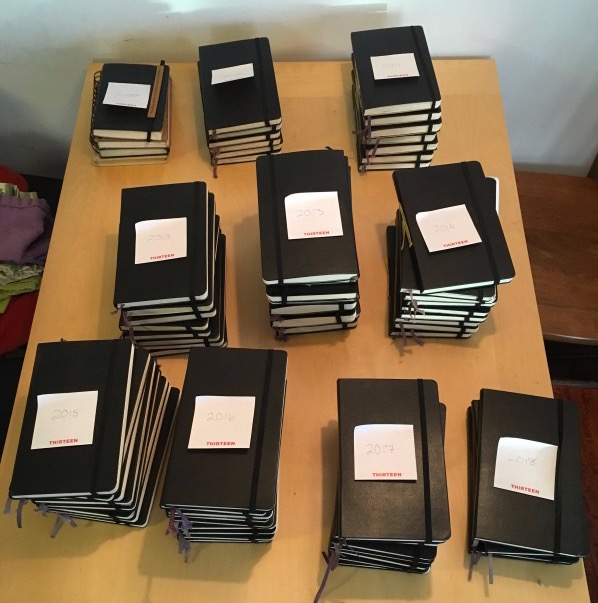
IMG_0026More than 10 years ago, I first attempted to work through “The Artists’s Way,” Julia Cameron’s 12-step program for those of us addicted to artistic procrastination and creative blockage. Over the past 3,356 days, I have written my version of “Morning pages” virtually every day. Some months, keeping up with this practice has proven too challenging. For example, five months encompassing the end of 2017 and early 2018 produced a dark age lacking any evidence of how vital this endeavor had become to my daily well-being. But that period aside, I estimate well-over 3,000 entries included within my 50-plus Moleskine notebooks.

As my 2 1/2-year-old son gets into everything, keeping him from scribbling in or ripping pages out of those notebooks has been challenging. So the other day, I pulled them off their easily accessible shelf, organized them by year, packed them into boxes, and took them to storage.

Should I have bothered? What do I do with them? Why have I kept them? I don’t know, but I can’t throw them away. At least not yet. Collectively, their existence sparks a lot of joy.

And I guess I feel the same way about this blog, which as I noted in my second post in Feb. 2004 took its name from my column for the The UCLA Daily Bruin. My time at the paper was both my first ongoing and consistent writing for public consumption as well as a major contributor to my never finishing my degree at UCLA. (That’s a long story for another time, however.)

My first published article elicited hate mail. The writer called my silly column “drivel,” and decried *The Daily Bruin* for giving such content a forum in its valuable pages. To be fair, the piece was, essentially, “drivel”: An unnecessary (and pretentious) attempt to announce my arrival as a critic and columnist to the UCLA community, presented in the guise of a dream featuring 1990’s most famous film critics welcoming me to their ranks and yelling “I’m right, you’re wrong!” at each other.

When my editor showed me the letter, I felt crushed. I hadn't even written my first review yet, and I've already received hate mail? The letter-writer was a stranger to me, and nobody else cared. If anything, everyone thought someone taking the time to write and mail (1990 here!) a letter about my column was a bit crazy. I still wrote reviews, participated in major press junkets, interviewed celebrities, attended the Spirit Awards and Oscars, and in 1992, the incoming Editor-in-Chief and Managing Editor drafted me as Editor of the A&E section. That single piece of hate mail had no lasting impact on my tenure there.

And yet, more than a quarter century later, not only do I vividly remember that crushing feeling, but here I am writing about it.

For me, that’s even more reason for my return to this secluded corner of the most public of spaces. So I’m back. For now. For today. Hopefully tomorrow? We’ll see. A few times each week, at least? That’s the minimal goal.

But no promises.

And I don’t really mind if nobody reads this. When I wrote that first column at UCLA, I wanted people to like it. I wanted people to like my writing. I wanted people to like me. But I wasn’t writing for me.

Now, I am.